
12 weeks to 4 years · 30 minutes sessions
Baby & toddler swimming
From twelve weeks old, in the water with you. Not on the side watching — in, holding them, the whole time.
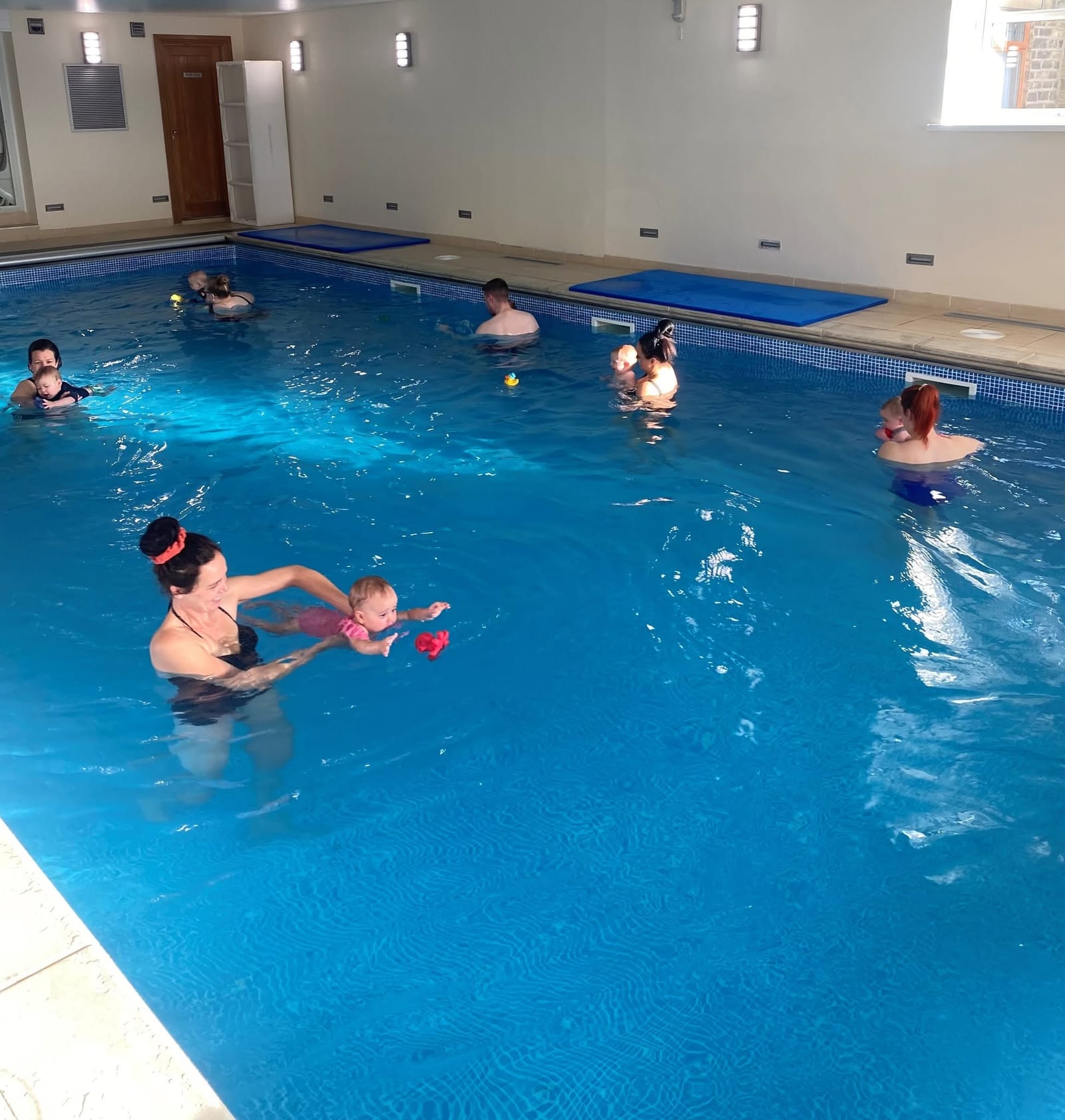
This is usually where it starts. Your baby's first time in a pool, with you holding them and a teacher beside you showing you both what to do.
Nobody expects a twelve-week-old to swim. What these lessons do is get your baby used to the water early, gently, and with you right there — so it's a normal, happy place long before it ever needs to be a safety skill.
As they grow into toddlers, the same class keeps going — more confidence, more independence in the water, still with you close by.
What happens in a session
- You're in the water with your baby the whole time — not watching from the poolside.
- The session follows the same shape every week — babies learn by repetition, and knowing what's coming is what builds the confidence. The activities inside it change, so it never goes stale.
- Nothing is ever forced. If your baby doesn't want to do something this week, that's fine — it's done with them, not to them.
- The pool is kept warm, because a cold baby doesn't enjoy much of anything.
Right for
- Babies from 12 weeks
- Toddlers
- First time in a pool
Swim nappies
All pre-schoolers wear a swim nappy underneath their swimwear until they're fully potty trained.
Once your child is fully potty trained and you're confident, they can come in swimwear on its own — the same as our older children and anyone else using the pool.
Most children stop wearing one around transition lessons. That tends to be the point parents feel comfortable, and there's no rush.
Water does two things nothing on land can
It takes your weight
Nothing jars and nothing pounds. Joints that have started complaining about a hard floor don't complain in water. For a lot of people it's the one kind of exercise still properly open to them.
And it pushes back
Water is far harder to move through than air, so every movement meets resistance — steady, even, and from every direction at once. You don't need weights; you're already working against something.
Which is an unusual combination: something that asks a great deal of your muscles and almost nothing of your joints.
It also means you can work harder in water than you can on land. Nothing is braking you — no impact to absorb, no landing to brace for — so you can push further than your knees would ever let you push on a pavement.
It's also one of the few things that gets more useful as you get older, not less. Plenty of people come to us having given up on exercise that hurts.
If you're swim fit, you're fit for anything.
People don't learn in cold water.
A cold child isn't learning anything except that they want to get out. A cold adult is holding their breath and bracing. Warm water is the first condition for teaching anybody anything in a pool.
You step in and there's no shock, no standing on the steps working up to it, no sharp breath. Ours sits at 33 degrees. Most pools run around 28, and five degrees is the difference between bracing yourself and just getting in.
We've babies in there, children, and plenty of women well over sixty. Our teachers are in the water for hours at a time. It has to be warm.
For a nervous swimmer that matters more than anything else on this page. The first thirty seconds decide how the rest of the lesson goes.
Price
- Per lesson
- £11
- Block of 4 lessons
- £44 — Paid every four weeks
You pay in four-week blocks, not a whole term up front — every payment covers four lessons.
What it costs to join
When you join, you pay for the lessons left in the current block, plus one block of four in advance. After that it's £44 every four weeks.
There's no assessment fee for baby and toddler classes — you go straight in. £5 covers a full set of certificates. Pay once when you join the baby classes and you get every baby certificate. Moving up to levelled lessons is a new set, so £5 again — and that covers all eight levels.
For example, joining with two lessons left in the block:certificates £5 + 2 lessons £22 + advance block £44 = £71.Join at a different point in the block and the number of lessons — and the total — changes. After your first payment it's always £44 every four weeks.
Ready to get your baby in the water?
Ogden Hall
24 Causeway Foot, Ogden, Halifax, HX2 8YB
There's a large car park on site, and it's free. You won't be hunting for a space.
Before you book, our Parent & Carer Code of Conduct, Safeguarding & Child Protection Policy and General Terms & Conditions are all published.